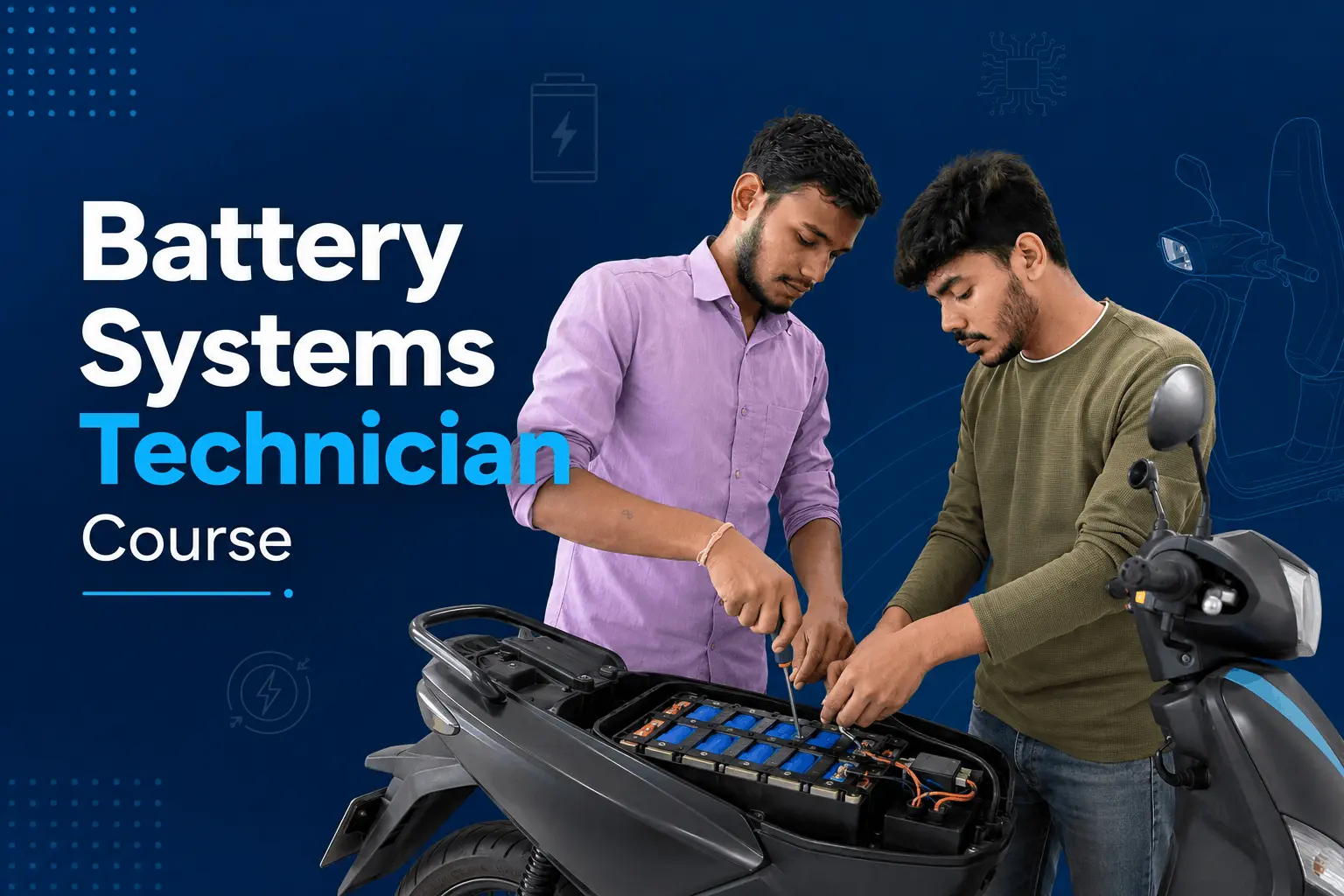



Battery Systems Technician Course

The Battery Systems Technician Course is designed to provide practical knowledge and hands-on skills in working with modern battery technologies. It covers battery types, construction, charging and discharging principles, safety practices, monitoring, and basic troubleshooting. Through real-world examples and lab-based training, learners gain experience in maintaining and handling battery systems used in electric vehicles, renewable energy storage, and industrial applications. This course prepares participants for technical roles supporting the rapidly growing battery and clean energy sectors.

Course Stats
4.5
256+ course reviews
Courses Hands-On Training
Languages English | हिन्दी
Career Placement Assistance

About Course

The Battery Systems Technician Course is a 108-hour practical training program.

It is designed to equip learners with the technical skills required to assemble, test, troubleshoot, and maintain battery systems used in electric vehicles (EVs), solar storage, UPS systems, and energy backup applications. The course covers battery chemistry fundamentals, pack construction, BMS operation, safety protocols, and diagnostic workflows, enabling participants to work confidently with modern lithium-ion and advanced battery technologies.

Through structured modules, participants learn:

– Battery fundamentals: Li-ion, LFP, NMC, lead-acid, and emerging chemistries
– Cell structure, ratings, C-rate, SoC/SoH concepts, and charge–discharge behavior
– Battery pack assembly: series/parallel configuration, busbars, welding methods
– Battery Management System (BMS): protection functions, balancing, communication
– Battery chargers, connectors, fuses, relays, and safety circuitry
– Thermal management, insulation, and enclosure design basics
– Common battery faults: cell imbalance, overvoltage/undervoltage, high temperature, BMS lockout
– Diagnostic tools: multimeter, cell testers, impedance meters, IR thermometers, CAN-based diagnostics (intro)
-Troubleshooting techniques and repair workflows
– Safety protocols, handling guidelines, and emergency response practices

Hands-on training includes cell testing, pack inspection, BMS configuration, identifying faulty cells, balancing procedures, thermal checks, connector repair, and assembling small battery modules with proper safety compliance.

By the end of the program, participants are prepared to:

– assemble and maintain battery packs for EVs and energy systems,
– diagnose and repair battery-related faults using professional tools, and
– work as Battery Systems Technicians, EV Battery Technicians, or Energy Storage Maintenance Technicians in EV service centers, battery manufacturing units, and renewable energy projects.

This course provides essential knowledge and practical training to build industry-relevant skills.

  • Online Course Fees: ₹2,500, ₹1,841 (incl. GST) (Excluding tools & equipment cost)
  • Offline Course Fees: ₹18,500, ₹16,638 (incl. GST) (Excluding tools & equipment cost)
  • Certification: TCoE
  • Duration: 108 Hours (2 hours/day x 6 days/week x 9 weeks) OR at your own pace

What you'll learn

Course Content

battery system technician

₹1,841

₹2,500
Discount 26.4% off

Benefits Obtained :

Success Stories from Our Learners

Join TCoE and gain practical knowledge, industry-recognized expertise, and the confidence to achieve your career goals.

Archisha Ahuja
Archisha Ahuja
B. Tech., IIT-Kharagpur
The Agricultural Drone Technology course was truly eye-opening! I learned how drones can transform farming by improving crop monitoring, reducing effort, and increasing productivity. The hands-on training gave me practical skills to operate and manage drones with confidence.
Aashman Gupta
Aashman Gupta
B. Des. Mumbai
The 3-D Printing and Drone Training course was awesome for me! I came in with only basic technical knowledge, but the hands-on approach made it easy to learn complex concepts. Designing and printing real models gave me the confidence to turn ideas into reality, while the drone training opened up exciting opportunities.
Shrishti
Shrishti
B. Tech., Amity University, Jaipur
The Raman Spectroscopy course gave me the knowledge of theory and practice. Hands-on training on Raman spectroscopy gave me an understanding the real-world applications. I now feel confident in applying Raman techniques for real research and innovation.
Aryan Gupta
Aryan Gupta
B. Sc. Physics, Netherlands
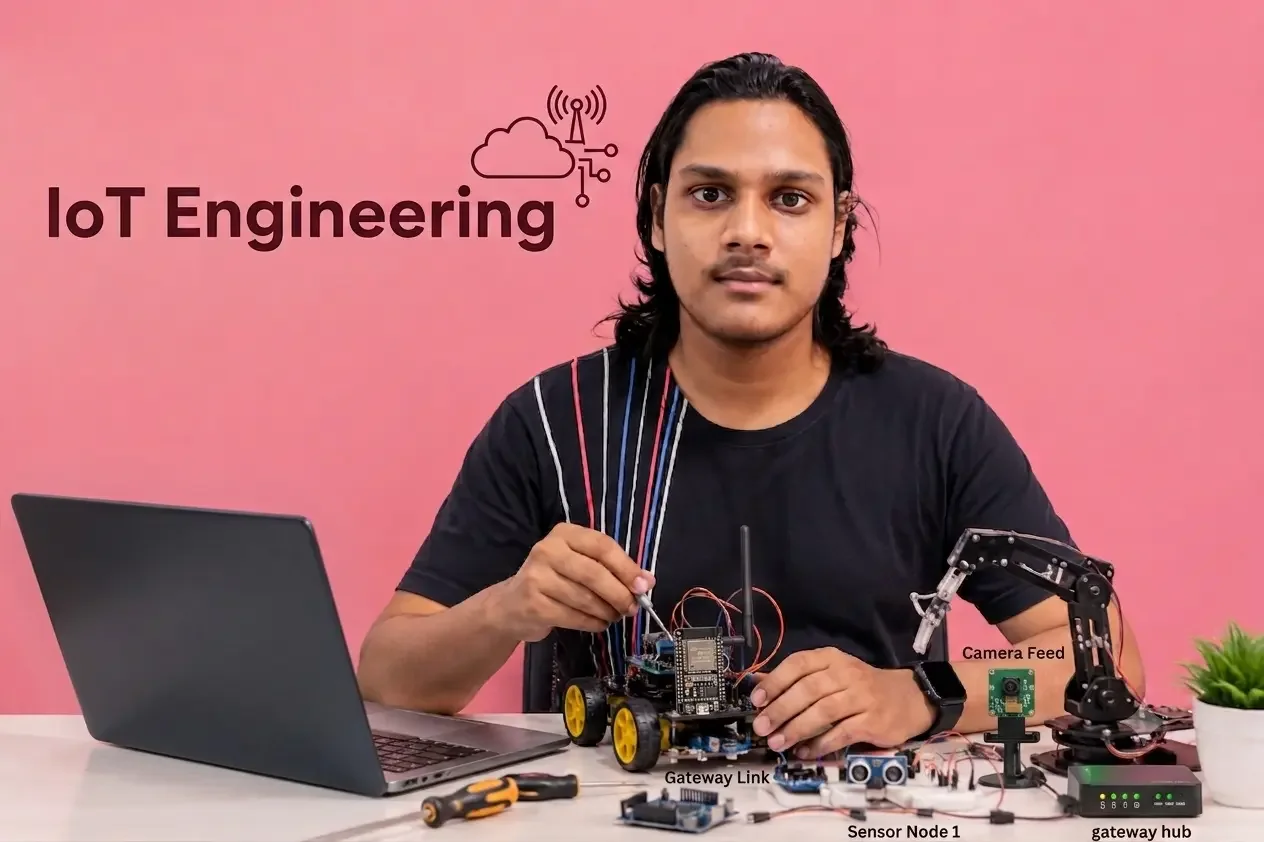
The IoT course transformed my understanding of technology! I never imagined I could connect devices, work with sensors, and create smart solutions so easily. The practical approach and step-by-step guidance made learning enjoyable and gave me skills that are truly future-ready.

Why Learn Battery Systems?

The Battery Systems Technician course is designed to provide learners with a comprehensive understanding of modern battery technologies, energy storage systems, and battery management techniques. As batteries become the backbone of electric vehicles (EVs), renewable energy systems, consumer electronics, and industrial applications, the demand for skilled professionals with expertise in battery systems is growing rapidly.

This course covers the fundamentals of battery chemistry, construction, operation, charging and discharging characteristics, Battery Management Systems (BMS), battery testing, diagnostics, maintenance, and safety. Through a combination of theoretical knowledge and hands-on practical training, learners will develop the skills needed to work with advanced battery technologies used across various industries.

DSC2866 scaled

By enrolling in this course, you will:

  • Build a strong foundation in battery technologies and energy storage systems.
  • Learn the working principles of lithium-ion, lead-acid, nickel-metal hydride (NiMH), and other battery types.
  • Understand battery charging, discharging, and performance characteristics.
  • Gain knowledge of Battery Management Systems (BMS) and their role in battery safety and efficiency.
  • Learn battery testing, diagnostics, fault detection, and troubleshooting techniques.
  • Develop practical skills in battery maintenance, replacement, and system integration.
  • Understand battery safety standards, thermal management, and handling procedures.
  • Explore battery applications in electric vehicles, renewable energy, industrial equipment, and consumer electronics.
  • Work on hands-on projects and practical demonstrations to strengthen your technical skills.
  • Prepare for careers in the rapidly growing battery and energy storage industry.

This course is ideal for engineering students, diploma holders, electricians, technicians, fresh graduates, EV enthusiasts, renewable energy professionals, and anyone interested in developing expertise in battery technologies and energy storage solutions.

Career Opportunities

After completing the Battery Systems Technician course, you can pursue roles such as:

  • Battery Systems Technician
  • Battery Service Engineer
  • Battery Testing Engineer
  • Battery Management System (BMS) Technician
  • EV Battery Technician
  • Energy Storage Systems Technician
  • Battery Maintenance Engineer
  • Battery Quality Control Engineer
  • Renewable Energy Technician
  • Electric Vehicle Service Engineer

Battery system professionals are in demand across electric vehicle manufacturers, battery manufacturing companies, renewable energy organizations, energy storage providers, consumer electronics companies, automotive service centers, industrial automation firms, research and development organizations, and battery recycling facilities.

Whether you are looking to start a career in electric mobility, renewable energy, or advanced energy storage technologies, the Battery Systems Technician course provides the technical foundation, practical experience, and industry-relevant skills needed to excel in one of the fastest-growing sectors of the global clean energy and electric vehicle ecosystem.

Frequently Asked Questions

Students, graduates, working professionals, entrepreneurs, and drone enthusiasts can enroll, subject to the eligibility requirements of the selected course.

No. Most beginner and intermediate courses do not require previous experience.

Eligibility varies by course. Please refer to the individual course page for the specific academic requirements.

Yes. Engineering, diploma, and ITI students can enroll to build practical drone technology skills.

Absolutely. Flexible learning options allow working professionals to upgrade their skills without interrupting their careers.

Our drone courses combine theoretical concepts with extensive hands-on practical training to help learners develop real-world skills.

Yes. Depending on the course, you’ll gain practical experience in drone assembly, servicing, maintenance, simulation, and flight operations.

Yes. Most courses start with the fundamentals and gradually progress to advanced concepts, making them suitable for beginners and professionals alike.

You’ll learn drone technology, safety procedures, troubleshooting, maintenance, flight operations, and industry best practices relevant to your chosen course.

Online courses focus on theoretical knowledge, while practical sessions may vary depending on the specific course and training format.

Yes. Eligible learners receive a course completion certificate after successfully meeting the course requirements.

Certification depends on the specific course. Several TechnosCOE drone programs include industry-recognized certifications such as ESSCI where applicable.

Yes. Online learners can complete eligible courses at their own pace within the provided access period.

Most courses are available in English and Hindi.

Course duration varies by program, ranging from a few weeks to several months.

Yes. Online learners can complete eligible courses at their own pace within the provided access period.

Most courses are available in English and Hindi.

Training schedules vary by batch and course mode. Please contact our team for the latest batch timings.

You will receive continuous support from experienced instructors through live doubt-clearing sessions, practical guidance, assignments, and technical discussions to help you succeed throughout the course.

Yes. Learners can reach out to instructors during designated doubt-clearing sessions or through the institute’s communication channels for additional guidance.

Yes. Instructors provide guidance throughout the project lifecycle, including project selection, implementation, debugging, testing, and documentation.

Yes. The support team assists learners with installing development tools, configuring software, and resolving basic hardware setup issues required for the course.

You can contact the support team through the institute’s official communication channels, such as email, phone, live chat, or the student support portal. The support team is available to assist with course-related queries, technical issues, and administrative requests.