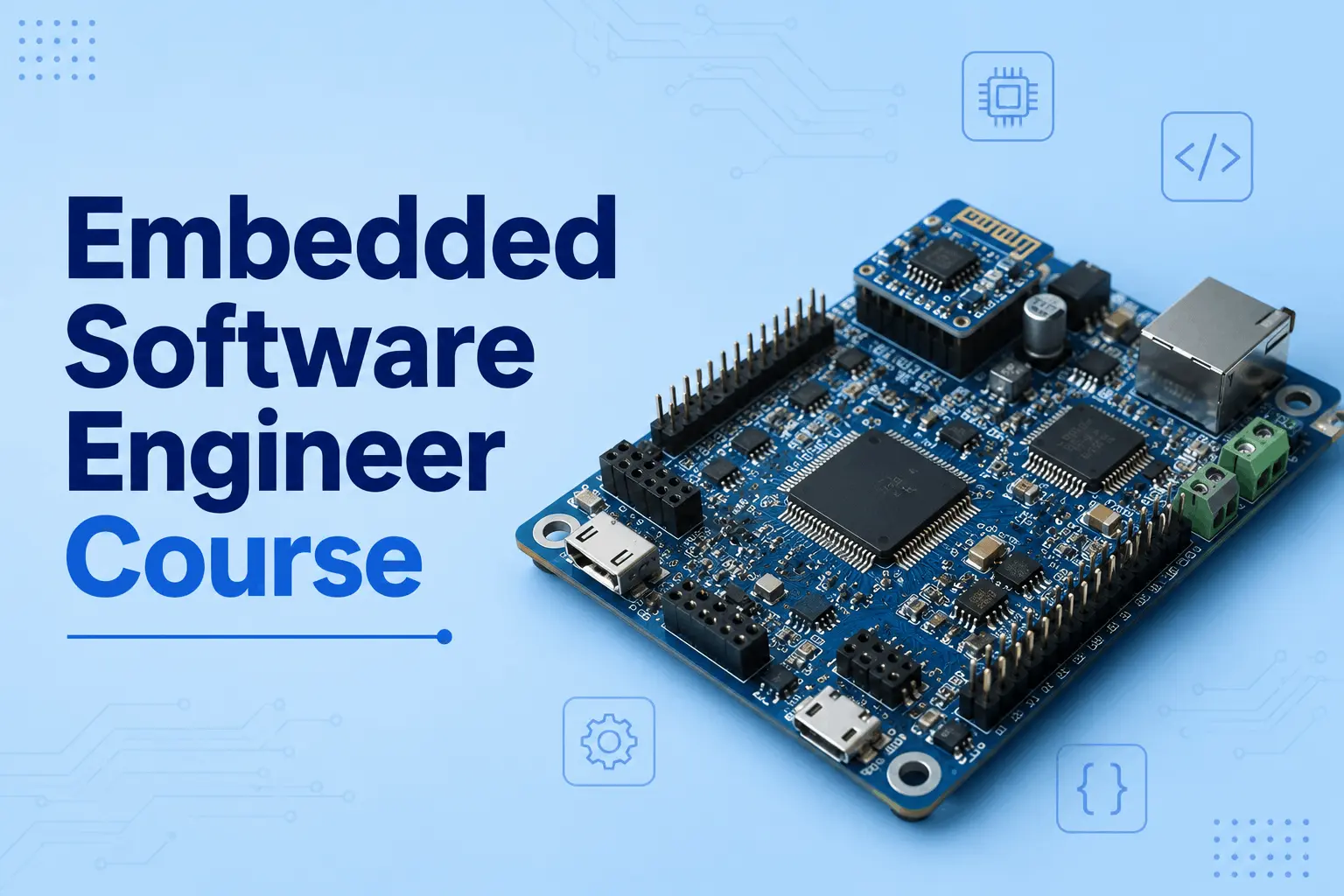

Embedded Software Engineer Course
Build job-ready skills in embedded software development with our ESSCI-approved Embedded Software Engineer Course. Learn to program microcontrollers, develop embedded applications, interface hardware, and troubleshoot real-world systems through practical training.
About Course
Embedded Software Engineer Course introduces the principles and practices of designing software for embedded systems that power everyday devices. The course covers microcontrollers, real-time operating systems, programming in C/C++, hardware-software integration, and debugging techniques. Students will gain hands-on experience in developing efficient, reliable, and optimized software solutions for applications in automotive systems, consumer electronics, IoT devices, and industrial automation.
Gain hands-on skills in embedded C programming, microcontroller interfacing, and real-time systems. Ideal for students aiming for careers in automation, robotics, or smart device development.
This Embedded Software Engineer training provides essential knowledge and practical training to build industry-relevant skills.
What you'll learn
- Demonstrate the process of developing embedded system software.
- Explain the importance of following inclusive practices for all genders and PwD at work.
- Demonstrate various practices to be followed to maintain health and safety at work.
Course Content
Program Overview
- Demonstrate the process of developing embedded system software.
- Explain the importance of following inclusive practices for all genders and PwD at work.
- Demonstrate various practices to be followed to maintain health and safety at work.
Module 1: Process of Understanding Project Needs Analysis and System Design using Agile and MBSE
- Describe the process of identifying the work requirement.
- Demonstrate the process of identifying the embedded system design specifications.
- Demonstrate the process of developing software for embedded system.
- Explain the importance of completing documentation.
Module 2: Process of Embedded Software Development with Modular Tools
- Understand the development procedure and documentation process.
Module 3: Process of Structured Digital Documentation with Quality and Traceability
- Understand the development procedure and documentation process.
Module 4: Employability Skills (60 Hours)
- Discuss about Employability Skills in meeting the job requirements.
- Describe opportunities as an entrepreneur.
- Describe ways of preparing for apprenticeship & Jobs appropriately.
Module 5: On-the-Job Training
- Interacting with the lead engineer for understanding the work schedules, shifts and
delivery dates. - Complying with organization’s policies, procedures and guidelines when developing
embedded system software codes. - Interacting with the lead engineer and embedded system design engineers.
- Creating a software design for the embedded system.
- Creating the software modules to meet the requirements of the software.
- Testing, verification and debugging of software codes for any errors and submitting the
tested codes and documents for approval. - Creating documents related to design using standard templates and agreed language
standards. - Communicating effectively at the workplace.
- Applying health and safety practices at the workplace.
Details to know
-
Online Course Fees -
₹5000₹2,649 (Incl. GST) |*Tools & equipment cost not included. -
Offline Course Fees -
₹28000₹24,131 (Incl. GST) - Certification - ESSCI
- Duration 570 Hours (6 hours/day x 5 days/week x 19 weeks) or at your own pace
Minimum Educational Qualification & Experience: Completed 2nd year of UG (UG Diploma) (Physics/Electronics/ Electrical/Computer Science) with 1.5 years of Relevant Experience Completed 3 year diploma after 10th (Electronics/Electrical/ Computer Science) with 3 Years of Relevant Experience OR Previous relevant Qualification of NSQF Level (4.5) with 1.5 years of Relevant Experience # Relevant Experience in Semiconductor & Components.
₹24,131
₹28,000
Discount 14% off
Course Highlights -
- Offline Mode*
- 570 Hours
- Basic & Intermediate
- Hindi, English
- Learn & Get Certified
Note – Minimum Class Strength: 25 Students
Explore Categories -
Related Course
Success Stories from Our Learners
Join TCoE and gain practical knowledge, industry-recognized expertise, and the confidence to achieve your career goals.
Why Learn Embedded Systems?
Embedded Software Engineering powers the technology behind smart devices, automobiles, medical equipment, robotics, industrial automation, and IoT systems. As connected and intelligent technologies continue to grow, skilled embedded software professionals are increasingly in demand.
Our Embedded Software Engineer Course provides practical knowledge of embedded systems, programming, firmware development, and hardware-software integration. Learners build skills in C/C++ programming, microcontroller programming, embedded Linux, RTOS, communication protocols, debugging, and real-world embedded projects.
With hands-on training and an industry-focused curriculum, this course helps learners develop the technical skills needed to design, program, test, and troubleshoot embedded systems and prepare for careers in embedded software development.
Build Your Embedded Software Career
Whether you are a student, electronics or computer engineering graduate, or a software professional, this course helps you develop practical skills for working with embedded systems. With growing applications of IoT, automation, robotics, automotive electronics, and smart devices, embedded software skills can open opportunities across multiple technology-driven industries.
Frequently Asked Questions
Q1. What skills will I learn in this course?
By the end of the course, you will learn:
- Embedded C and C++ programming
- Microcontroller programming
- Embedded Linux fundamentals
- Real-Time Operating Systems (RTOS)
- Communication protocols (UART, SPI, I2C, CAN)
- Device driver basics
- Firmware development and debugging
- Hardware-software interfacing
- IoT and embedded application development
- Industry-standard tools and project development
These skills prepare you for real-world embedded software development.
Q2. Are there any prerequisites for this course?
No prior experience in embedded systems is required. However, having a basic understanding of programming concepts, computer fundamentals, and digital electronics can help you learn more quickly. The course starts with the fundamentals and gradually progresses to advanced topics.
Q3. What career opportunities are available after completing this course?
After successfully completing the course, you can apply for roles such as:
- Embedded Software Engineer
- Firmware Engineer
- Embedded Systems Developer
- Embedded Linux Developer
- IoT Developer
- Automotive Embedded Engineer
- Device Driver Developer
- Robotics Software Engineer
Embedded software professionals are in demand across industries such as automotive, consumer electronics, medical devices, aerospace, industrial automation, telecommunications, and IoT.
Q4. Does the course include practical projects and hands-on training?
Yes. The course emphasizes practical learning through hands-on labs, programming exercises, hardware interfacing, debugging sessions, and real-world projects. These projects help you gain industry-relevant experience, strengthen your portfolio, and improve your confidence for technical interviews and job opportunities.
Q5. Which programming languages are covered in this course?
The course primarily focuses on Embedded C, which is the industry standard for firmware development. It also introduces C++ concepts used in embedded applications.
Q1. What is the duration of the Embedded Software Engineer course?
The course duration is typically 6 months and is offline mode.
Q2. Can I attend the course online from any location?
This course is available offline only and physical attendance is mandatory.
Q3. Is the course suitable for working professionals?
Absolutely. But attendance mandatory for this course.
Q4. How much time should I dedicate each week?
6 hours per day and 5 days per week attendance is mandatory for this course.
Q1. How long does the course take to complete?
Course duration varies by program, ranging from a few weeks to several months.
Q2. Can I learn at my own pace?
Yes. Online learners can complete eligible courses at their own pace within the provided access period.
Q3. What languages are the courses available in?
Most courses are available in English and Hindi.
Q4. Are weekend or flexible schedules available?
Training schedules vary by batch and course mode. Please contact our team for the latest batch timings.
Q1. What kind of support will I receive during the course?
You will receive continuous support from experienced instructors through live doubt-clearing sessions, practical guidance, assignments, and technical discussions to help you succeed throughout the course.
Q2. Can I contact the instructor if I have doubts after class?
Yes. Learners can reach out to instructors during designated doubt-clearing sessions or through the institute’s communication channels for additional guidance.
Q3. Will I receive support for course projects?
Yes. Instructors provide guidance throughout the project lifecycle, including project selection, implementation, debugging, testing, and documentation.
Q4. Is technical support available if I face issues with software or hardware setup?
Yes. The support team assists learners with installing development tools, configuring software, and resolving basic hardware setup issues required for the course.
Q5. How can I contact the support team for further assistance?
You can contact the support team through the institute’s official communication channels, such as email, phone, live chat, or the student support portal. The support team is available to assist with course-related queries, technical issues, and administrative requests.
Q1. Who is eligible to enroll in the Embedded Software Engineer course?
Completed 2nd year of UG (UG Diploma) (Physics/Electronics/ Electrical/Computer Science) with 1.5 years of Relevant Experience Completed 3 year diploma after 10th (Electronics/Electrical/ Computer Science) with 3 Years of Relevant Experience OR Previous relevant Qualification of NSQF Level (4.5) with 1.5 years of Relevant Experience # Relevant Experience in Semiconductor & Components.
Q2. Which educational backgrounds are suitable for this course?
This course is ideal for candidates from:
- Electronics & Communication Engineering (ECE)
- Electrical & Electronics Engineering (EEE)
- Computer Science Engineering (CSE)
- Information Technology (IT)
- Electronics & Instrumentation (E&I)
- Mechatronics
- Robotics
- Other related engineering or technical disciplines
Q3. Can final-year engineering students join this course?
Yes. Final-year engineering students are encouraged to enroll, as the course helps them develop industry-relevant skills and improve their placement opportunities before graduation.
Q4. Can working professionals enroll in this course?
Yes. Working professionals who wish to transition into embedded systems or enhance their existing technical skills can join the course. Flexible weekday, evening, and weekend batches are often available.
Q5. Is prior programming knowledge required?
No. Prior programming experience is not mandatory. The course starts with the fundamentals of programming and gradually progresses to advanced embedded software concepts.