

Drone Assembly Technician Course
TCoE Drone Assembly Technician Course offers hands-on training in building, calibrating, and testing drones using key components like motors, sensors, and flight controllers.
About Course
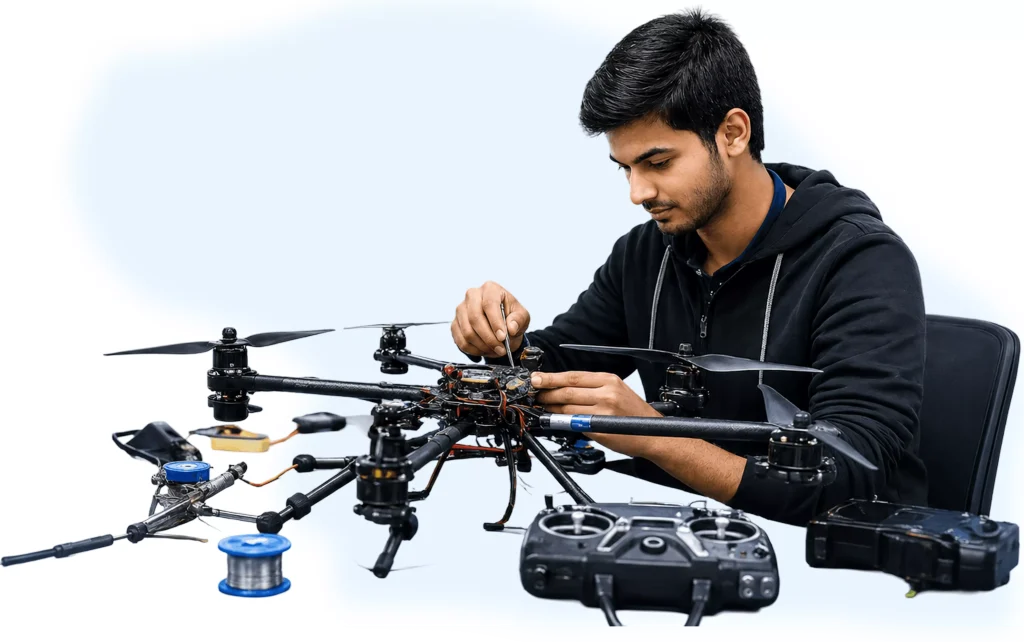
Drone Assembly Technician Course is a hands-on skill development course designed to train learners in building, assembling, and testing unmanned aerial vehicles (UAVs) from the ground up. The course covers key components such as frames, motors, propellers, flight controllers, ESCs, power systems, wiring, and basic payload integration. Learners gain practical knowledge of drone electronics, mechanical assembly, calibration, safety practices, and basic troubleshooting.
This course prepares students for entry-level roles in drone manufacturing, maintenance, startups, and service centers, supporting the rapidly growing drone ecosystem across industries such as agriculture, surveying, logistics, defense, and inspection. This course provides essential knowledge and practical training to build industry-relevant skills.
What you'll learn
- Drone Basics & Components – Understand drone types, frames, motors, ESCs, propellers, flight controllers, and power systems.
- Mechanical Assembly Skills – Learn how to assemble frames, mount motors, balance propellers, and integrate structural components.
- Electrical Wiring & Soldering – Gain hands-on skills in wiring, soldering, connector assembly, power distribution, and circuit safety.
- Flight Controller Setup – Configure flight controllers (like Pixhawk, APM, Betaflight), calibrate sensors, and perform firmware setup.
- Sensor & Module Integration – Install and integrate GPS, IMU, barometer, telemetry modules, and payload systems.
- Battery & Power Management – Understand LiPo batteries, charging safety, voltage regulation, and power optimization techniques.
- Testing, Tuning & Troubleshooting – Perform pre-flight checks, PID tuning, signal testing, vibration analysis, and common fault diagnosis.
- Drone Safety & Compliance – Learn safe handling, assembly standards, maintenance practices, and basic regulatory guidelines.
Course Content
Mostly practical training from the first day.
Details to know
-
Online Course Fees -
₹1300₹850 (Incl. GST) |*Tools & equipment cost not included. -
Offline Course Fees -
₹8,500₹6,726 (Incl. GST) |*Tools & equipment cost not included. - Certification - TCoE
- Duration 36 Hours (2 hours/day x 6 days/week x 6 weeks) or at your own pace.
₹850
₹1,300
Discount 35% off
Benefits Obtained :
- 3 weeks
- 12 Hours / Week
- Basic & Intermediate
- Hindi, English
- Learn & Get Certified
Related Course
Success Stories from Our Learners
Join TCoE and gain practical knowledge, industry-recognized expertise, and the confidence to achieve your career goals.
Drone Assembly Courses
Build a Future-Ready Career in Drone Technology with TCoE...
The drone industry is expanding at an incredible pace, transforming sectors such as agriculture, construction, surveying, mapping, surveillance, filmmaking, logistics, and infrastructure inspection. As businesses increasingly adopt drone technology to improve efficiency and reduce costs, the demand for skilled professionals who can assemble, maintain, and troubleshoot drones continues to grow. **Drone Assembly Courses** equip learners with practical, industry-relevant skills to build, test, and service advanced UAVs while understanding the technology behind their performance. Whether you’re starting a career or upgrading your technical expertise, these courses provide the knowledge and hands-on experience needed to succeed in the rapidly evolving drone industry.
Why Drone Assembly Courses Are in High Demand
Enrolling in drone assembly Courses is one of the most practical ways to enter the drone ecosystem. These programs are designed to provide deep, hands-on exposure to drone hardware and system integration. Instead of just theoretical learning, students work directly with real components such as frames, motors, propellers, flight controllers, ESCs, and power distribution systems.
By the end of the training, learners gain the ability to assemble drones from scratch, identify technical issues, and perform basic troubleshooting with confidence. This practical skill set is highly valued in today’s rapidly growing UAV (Unmanned Aerial Vehicle) market.
What You Learn in Drone Building Courses
- Learn the complete process of building and engineering modern drones (UAVs).
- Understand drone electronics and circuit integration.
- Choose the right batteries and optimize power performance.
- Configure and calibrate flight controllers for stable flights.
- Install firmware and set up drone software.
- Learn propeller balancing and basic aerodynamics.
- Follow industry-standard drone safety and operating practices.
- Build, test, and optimize high-performance drones.
- Develop practical skills for careers in drone manufacturing, maintenance, and technical support.
Career Advantage of Drone Assembly Technician Course
For those aiming for professional roles, a Drone Assembly Technician Course offers industry-focused training. This course prepares learners for real-world job responsibilities such as drone inspection, preventive maintenance, repair diagnostics, and quality assurance testing.
Graduates of this program can explore career opportunities in drone manufacturing companies, repair centers, research labs, surveying firms, and commercial drone service providers. With the increasing adoption of drone technology, certified technicians are becoming highly sought after across industries.
Whether you are a beginner or a technology enthusiast, enrolling in drone assembly Courses can open the door to a promising career in the UAV industry. Combined with advanced drone building Courses and a specialized Drone Assembly Technician Course, you can develop the technical expertise needed to succeed in this fast-growing field.
As drone technology continues to evolve, skilled professionals will remain in high demand. Now is the perfect time to invest in your future and become part of the next generation of drone innovators.
Frequently Asked Questions
Q1. Who is eligible to join this drone course?
Students, graduates, working professionals, entrepreneurs, and drone enthusiasts can enroll, subject to the eligibility requirements of the selected course.
Q2. Do I need prior drone experience?
No. Most beginner and intermediate courses do not require previous drone experience.
Q3. What is the minimum educational qualification?
Eligibility varies by course. Please refer to the individual course page for the specific academic requirements.
Q4. Can engineering and diploma students join?
Yes. Engineering, diploma, and ITI students can enroll to build practical drone technology skills.
Q5. Can working professionals attend the course?
Absolutely. Flexible learning options allow working professionals to upgrade their skills without interrupting their careers.
Q1. Is this course practical or theory-based?
Our drone courses combine theoretical concepts with extensive hands-on practical training to help learners develop real-world skills.
Q2. Will I work with actual drones during the course?
Yes. Depending on the course, you’ll gain practical experience in drone assembly, servicing, maintenance, simulation, and flight operations.
Q3. Are the courses suitable for beginners?
Yes. Most courses start with the fundamentals and gradually progress to advanced concepts, making them suitable for beginners and professionals alike.
Q4. What skills will I gain after completing the training?
You’ll learn drone technology, safety procedures, troubleshooting, maintenance, flight operations, and industry best practices relevant to your chosen course.
Q5. Is hands-on training included in online courses?
Online courses focus on theoretical knowledge, while practical sessions may vary depending on the specific course and training format.
Q1. Will I receive a certificate after completing the course?
Yes. Eligible learners receive a course completion certificate after successfully meeting the course requirements.
Q2. Is the certificate recognized by the industry?
Certification depends on the specific course. Several TechnosCOE drone programs include industry-recognized certifications such as ESSCI where applicable.
Q3. Do I need to pass an assessment to earn the certificate?
Yes. Online learners can complete eligible courses at their own pace within the provided access period.
Q4. Can I use the certificate while applying for jobs?
Most courses are available in English and Hindi.
Q1. How long does the course take to complete?
Course duration varies by program, ranging from a few weeks to several months.
Q2. Can I learn at my own pace?
Yes. Online learners can complete eligible courses at their own pace within the provided access period.
Q3. What languages are the courses available in?
Most courses are available in English and Hindi.
Q4. Are weekend or flexible schedules available?
Training schedules vary by batch and course mode. Please contact our team for the latest batch timings.
Q1. What kind of support will I receive during the course?
You will receive continuous support from experienced instructors through live doubt-clearing sessions, practical guidance, assignments, and technical discussions to help you succeed throughout the course.
Q2. Can I contact the instructor if I have doubts after class?
Yes. Learners can reach out to instructors during designated doubt-clearing sessions or through the institute’s communication channels for additional guidance.
Q3. Will I receive support for course projects?
Yes. Instructors provide guidance throughout the project lifecycle, including project selection, implementation, debugging, testing, and documentation.
Q4. Is technical support available if I face issues with software or hardware setup?
Yes. The support team assists learners with installing development tools, configuring software, and resolving basic hardware setup issues required for the course.
Q5. How can I contact the support team for further assistance?
You can contact the support team through the institute’s official communication channels, such as email, phone, live chat, or the student support portal. The support team is available to assist with course-related queries, technical issues, and administrative requests.