
Solar Battery Energy Storage System Courses
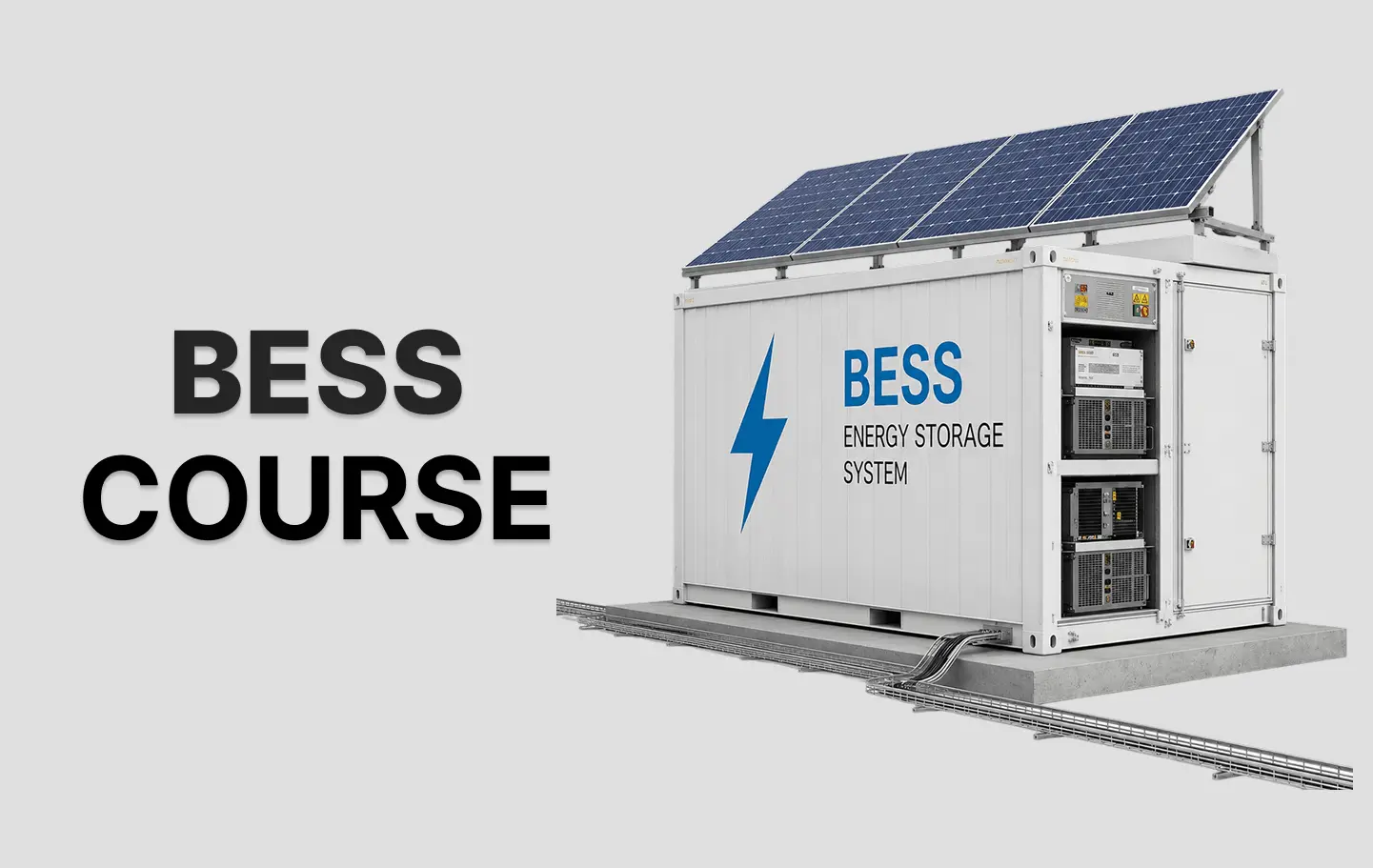
Power your solar future with Battery Energy Storage System (BESS) Courses designed to build practical skills in energy storage, battery management, and solar integration. Learn to design, install, operate, and maintain solar energy storage systems for reliable and efficient power solutions.
About Course
Solar PV & Battery Energy Storage System Course is a 72-hour practical training program designed to build industry-ready skills in solar PV installation and battery energy storage systems (BESS).
Learn solar PV fundamentals, system design, inverters, BOS components, electrical wiring, installation, BESS integration, safety, maintenance, and troubleshooting through hands-on training. Gain the practical confidence to pursue opportunities as a Solar PV Engineer, Project Engineer, Design Engineer, or Field Engineer in the renewable energy industry.
What you'll learn
- Fundamentals of Solar Energy: Understand the basics of solar radiation, photovoltaic effect, and how sunlight is converted into usable electricity.
- Overview of Solar PV Components: Learn about key system components such as PV modules, inverters, batteries, charge controllers, mounting structures, and cabling.
- Types of Solar PV Systems: Get familiar with on-grid, off-grid, and hybrid systems, and their real-world applications.
- Basic System Design Principles: Gain introductory skills in calculating energy requirements, sizing PV modules, selecting inverters, and planning simple PV layouts.
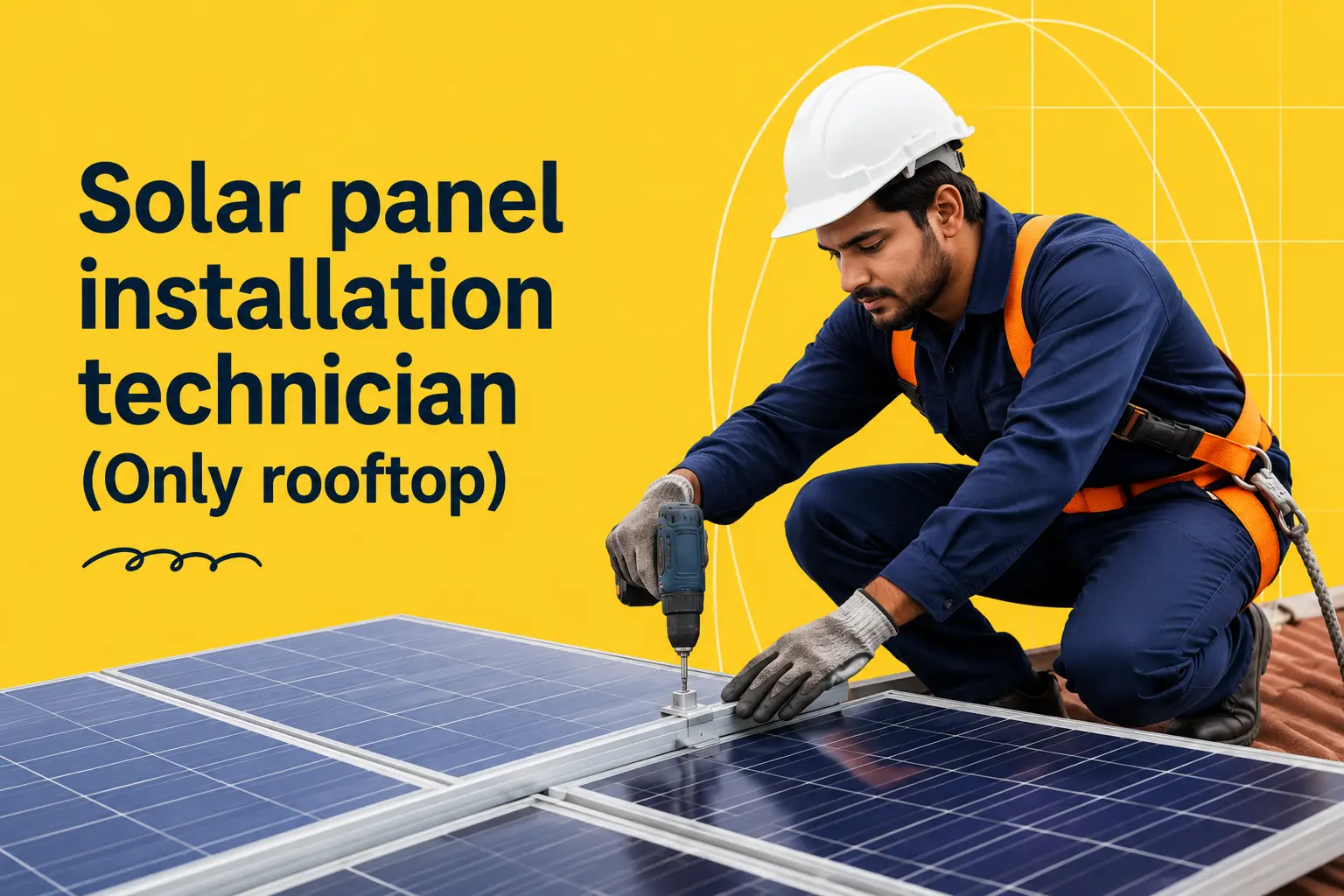
- Installation Techniques & Safety: Understand basic installation procedures, tools required, wiring practices, and essential safety protocols to prevent electrical and structural hazards.
- Site Assessment & Survey Basics: Learn how to evaluate rooftops or open areas for solar installation, including shading analysis and orientation considerations.
- Operation & Maintenance Essentials: Acquire basic knowledge of routine maintenance, system inspection, cleaning procedures, and identifying common system issues.
- Introduction to Solar PV Standards & Policies: Get an overview of relevant standards, certification requirements, and government policies supporting solar deployment.
Course Content
Fundamentals of BESS
- BESS definition and purpose/ its need.
- Types of Battery Technologies [Lithium-ion (NMC, LFP, LTO), Lead-acid, Nickel-based, Flow batteries] and their market availability.
Practical: Pictures of different technology batteries of same power rating so that they could be compared for various performance parameters.
- Key components of BESS systems [Cells, BMS, PCS, Control & monitoring, cooling, fire suppression]
- Performance Characteristics [Capacity (total and usable), power rating, energy density, and specific energy/power, State of Charge (SoC). Depth of Discharge (DoD), Efficiency and round-trip efficiency, response time, lifecycle]
Practical: Picture of a battery which is being used presently highlighting its specifications and calculating performance parameters using specifications.
- System Configurations [AC coupled / DC coupled, standalone / grid connected / hybrid]
- Applications and Benefits [Grid stability, frequency regulation, peak shaving, backup power, renewable integration, micro-grids]
BESS Sizing for solar PV integration-
- Assessment of PV Generation profile [ Analysis of solar resource variability and intermittency, Load matching and demand profile evaluation]
Practical: Power demand curve and its use in load matching and peak shaving.
- Determination of the BESS role [Output smoothing, peak shaving, load shifting, frequency regulation, backup power]
- Battery sizing methodologies [Energy capacity calculation (kWh) based on application and PV variability, Power rating (kW) requirements for response speed and grid support, Sizing for specific use-cases (e.g., smoothing, time-shifting, backup), Consideration of battery degradation and oversizing for lifecycle]
Practical: Battery sizing calculation for an Indian house as a case study.
- State of Charge (SoC) Management [SOC limits for optimal battery health, Sizing approaches that maintain SOC at start and end of cycle]
- Component Selection [Battery technology selection, battery pack series/parallel configuration, BMS components)
BESS installation hands on documents-
- Single white paper
Details to know
-
Online Course Fees -
₹10,000₹3000 (Incl. GST) |*Tools & equipment cost not included. -
Offline Course Fees -
₹18,000₹12,000 (Incl. GST) - Certification - ESSCI
- Duration 72 Hours (2 hours/day x 6 days/week x 6 weeks) or at your own pace
₹3000
₹10,000
Discount 70% off
Benefits Obtained :
- Offline Mode
- 72 Hours
- Basic & Intermediate
- Hindi, English
- Learn & Get Certified
Explore Categories -
Related Course
Embedded IoT Specialist Course by Expert
Success Stories from Our Learners
Join TCoE and gain practical knowledge, industry-recognized expertise, and the confidence to achieve your career goals.
Frequently Asked Questions
Q1. Who is eligible to join this course?
Students, graduates, working professionals, entrepreneurs, and enthusiasts can enroll. However, please refer to the course page above for any specific requiements.
Q2. Do I need prior experience?
No. Most beginner and intermediate courses do not require previous experience.
Q3. What is the minimum educational qualification?
Eligibility varies by course. Please refer to the course page for the specific academic requirements.
Q4. Can engineering and diploma students join?
Yes. Engineering, diploma, and ITI students can enroll to build practical skills.
Q5. Can working professionals attend the course?
Absolutely. Flexible learning options allow working professionals to upgrade their skills without interrupting their careers.
Q1. Is this course practical or theory-based?
Our courses combine theoretical concepts with extensive hands-on practical training to help learners develop real-world skills.
Q2. Are the courses suitable for beginners?
Yes. Most courses start with the fundamentals and gradually progress to advanced concepts, making them suitable for beginners and professionals alike.
Q3. Is hands-on training included in online courses?
Online courses focus on theoretical knowledge, while practical sessions may vary depending on the specific course and training format. Please refer to the course page above for more details.
Q1. Will I receive a certificate after completing the course?
Yes. Eligible learners receive a course completion certificate after successfully meeting the course requirements.
Q2. Is the certificate recognized by the industry?
Certification depends on the specific course. Several TechnosCOE programs include industry-recognized certifications such as ESSCI where applicable.
Q3. Do I need to pass an assessment to earn the certificate?
Yes. Online learners can complete eligible courses at their own pace within the stipulated time.
Q4. Can I use the certificate while applying for jobs?
Most courses are available in English and Hindi.
Q1. How long does the course take to complete?
Course duration varies by program, ranging from a few weeks to several months.
Q2. Can I learn at my own pace?
Yes. Learners can complete eligible courses at their own pace within the stipulated time.
Q3. What languages are the courses available in?
Most courses are available in English and Hindi.
Q4. Are weekend or flexible schedules available?
Training schedules vary by batch and course mode. Please contact our team for the latest batch timings.
Q1. What kind of support will I receive during the course?
You will receive continuous support from experienced instructors through live doubt-clearing sessions, practical guidance, assignments, and technical discussions to help you succeed throughout the course.
Q2. Can I contact the instructor if I have doubts after class?
Yes. Learners can reach out to instructors during designated doubt-clearing sessions or through the institute’s communication channels for additional guidance.
Q3. Will I receive support for course projects?
Yes. Instructors provide guidance throughout the project lifecycle, including project selection, implementation, debugging, testing, and documentation.
Q4. Is technical support available if I face issues with software or hardware setup?
Yes. The support team assists learners with installing development tools, configuring software, and resolving basic hardware setup issues required for the course.
Q5. How can I contact the support team for further assistance?
You can contact the support team through the institute’s official communication channels, such as email, phone, live chat, or the student support portal. The support team is available to assist with course-related queries, technical issues, and administrative requests.