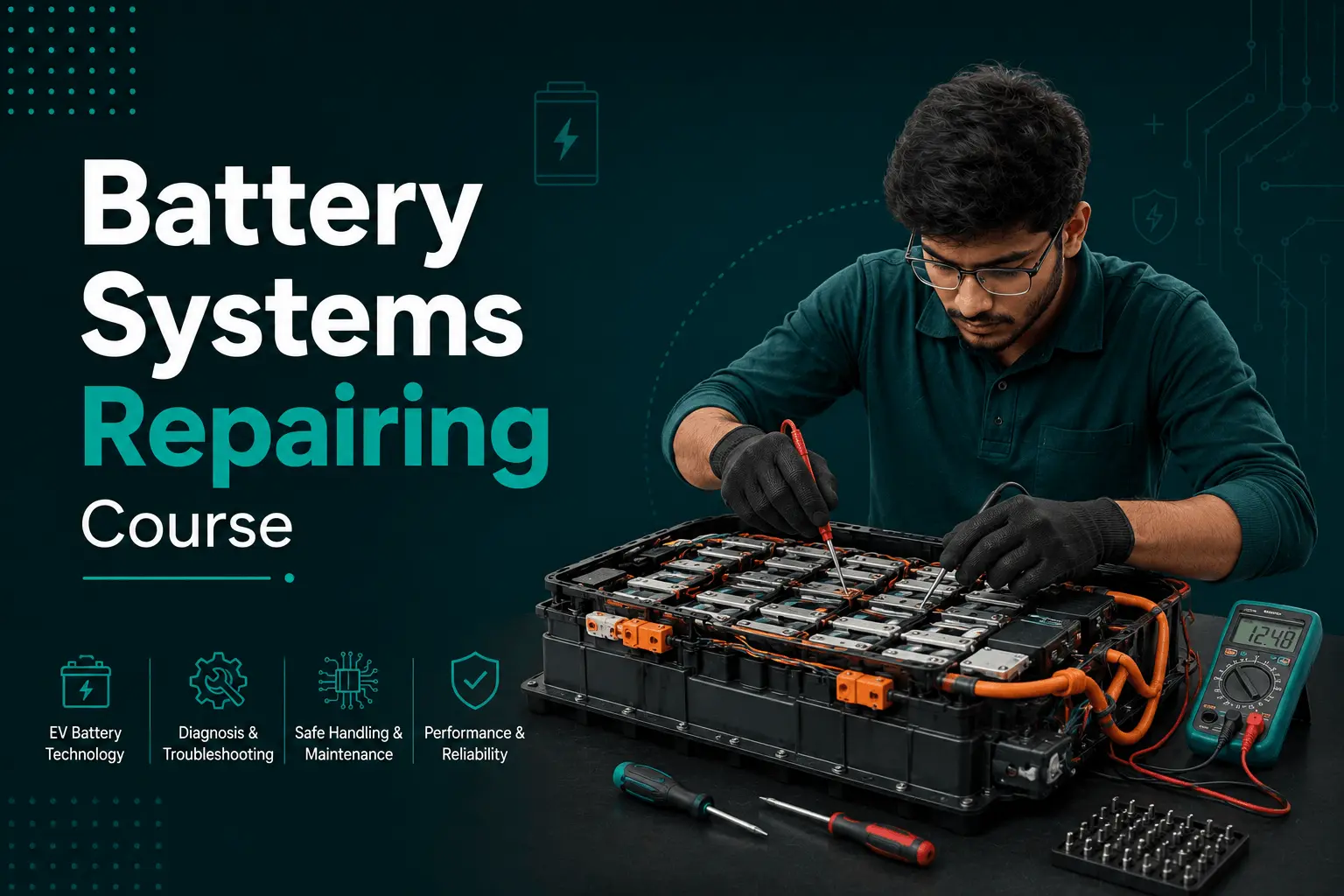


Battery System Repair Technician Course
The Battery System Repair Technician Course trains learners to diagnose, troubleshoot, and repair electric vehicle battery systems with precision and safety. Participants gain hands-on experience in identifying faults, replacing modules, calibrating Battery Management Systems (BMS), and performing performance and safety tests. Designed for technicians and EV enthusiasts, this course equips learners with practical skills to maintain, repair, and optimize EV batteries, preparing them for in-demand roles in workshops, service centers, and the expanding electric mobility industry.
About Course
Battery System Repair Technician Course focuses on the skills and knowledge required to diagnose, repair, and maintain battery systems, particularly in electric vehicles and energy storage applications. The course covers battery structure, common faults, testing tools, safety protocols, and repair techniques. Students will gain hands-on training in troubleshooting and servicing battery packs to ensure performance, reliability, and safety.
Gain skills to diagnose, repair, and maintain battery systems used in electric vehicles and energy storage, ensuring performance and safety.
- Online Course Fees: ₹3500, ₹2500 (incl. GST) (Excluding tools & equipment cost)
- Offline Course Fees: ₹18500, ₹17000 (incl. GST) (Excluding tools & equipment cost)
- Certification: ESSCI
- Duration: 450 Hours (2 hours/day x 6 days/week x 38 weeks) OR at your own pace
What you'll learn
- Basics of Battery Technologies: Understand the fundamentals of Li-ion, LFP, NMC, lead-acid, and EV-grade battery packs used in electric vehicles and energy storage systems.
- Battery Pack Architecture & Components: Learn the internal structure of battery modules, cells, busbars, cooling arrangements, BMS wiring, fuses, relays, and safety components.
- Diagnostic Tools & Testing Procedures: Gain hands-on experience with multimeters, insulation testers, cell capacity testers, IR testers, thermal cameras, and battery analyzers.
- Fault Identification & Troubleshooting: Learn to diagnose issues like cell imbalance, overheating, low capacity, insulation faults, BMS communication errors, and wiring failures.
- Battery Disassembly & Repair Techniques: Understand safe disassembly of packs, busbar removal, cell replacement, re-spot welding, reconnecting terminals, and module-level repairs.
- Battery Management System (BMS) Basics: Learn how the BMS monitors voltage, current, temperature, SOC/SOH, protections, and how to reset/update/configure BMS after repairs.
- Reassembly, Balancing & Performance Validation: Master techniques for pack rebuilding, active/passive balancing, thermal management checks, and final performance testing before deployment.
- Battery Safety, Handling & Disposal Protocols: Understand fire safety, PPE usage, hazard prevention, transportation rules, and safe disposal or recycling of damaged cells and packs.
Course Content
Mostly practical training from the first day.
₹1,935
₹2600
Discount 26% off
Benefits Obtained :
- 15 weeks
- 30 Hours / Week
- Basic & Intermediate
- Hindi, English
- Learn & Get Certified
Related Course
Success Stories from Our Learners
Join TCoE and gain practical knowledge, industry-recognized expertise, and the confidence to achieve your career goals.
Why Learn Battery Systems Repair?
The Battery Systems Repair course is designed to provide learners with the technical knowledge and practical skills required to diagnose, repair, maintain, and restore modern battery systems used in electric vehicles (EVs), renewable energy systems, industrial equipment, and energy storage applications. As battery technology continues to evolve and power the transition toward sustainable energy, skilled battery repair professionals are in high demand across multiple industries.
Rather than replacing expensive battery packs, many organizations now focus on battery diagnostics, cell-level repair, balancing, and maintenance to extend battery life and reduce costs. This course equips learners with the expertise to identify battery faults, perform safe repairs, replace defective components, and ensure optimal battery performance using industry-standard tools and procedures.
Throughout the course, learners will gain hands-on experience with lithium-ion batteries, Battery Management Systems (BMS), battery pack assembly, cell testing, thermal management, charging systems, fault diagnosis, and safety protocols. Practical training and real-world repair scenarios help learners build the confidence needed to work with advanced battery technologies.
By enrolling in this course, you will:
- Build a strong foundation in battery technologies and repair techniques.
- Understand the construction and operation of lithium-ion and other rechargeable battery systems.
- Learn battery pack disassembly, inspection, and reassembly procedures.
- Gain practical skills in battery testing, diagnostics, and fault identification.
- Understand Battery Management Systems (BMS) and their role in battery performance and safety.
- Learn cell balancing, module replacement, and battery restoration techniques.
- Develop expertise in charging systems, battery maintenance, and preventive servicing.
- Follow industry-standard safety practices for handling high-energy battery systems.
- Work on hands-on repair projects and real-world troubleshooting scenarios.
- Prepare for careers in the growing electric vehicle, energy storage, and battery service industries.
This course is ideal for engineering students, diploma holders, electricians, technicians, EV service professionals, renewable energy enthusiasts, fresh graduates, entrepreneurs, and anyone interested in developing specialized skills in battery repair and maintenance.
Career Opportunities
After completing the Battery Systems Repair course, you can pursue roles such as:
- Battery Systems Repair Technician
- EV Battery Repair Technician
- Battery Service Engineer
- Battery Maintenance Technician
- Battery Diagnostic Technician
- Battery Pack Assembly Technician
- Battery Management System (BMS) Technician
- Energy Storage Systems Technician
- EV Service Technician
- Renewable Energy Service Technician
Battery repair professionals are in demand across electric vehicle manufacturers, battery manufacturing companies, EV service centers, renewable energy organizations, energy storage providers, battery refurbishment companies, automotive workshops, industrial maintenance firms, and battery recycling facilities.
Whether you are beginning your career, upgrading your technical expertise, or looking to specialize in battery repair, the Battery Systems Repair course provides the practical training, industry knowledge, and hands-on experience needed to succeed in one of the fastest-growing sectors of the electric mobility and renewable energy industry.
Frequently Asked Questions
Q1. Who is eligible to join this course?
Students, graduates, working professionals, entrepreneurs, and drone enthusiasts can enroll, subject to the eligibility requirements of the selected course.
Q2. Do I need prior experience?
No. Most beginner and intermediate courses do not require previous experience.
Q3. What is the minimum educational qualification?
Eligibility varies by course. Please refer to the individual course page for the specific academic requirements.
Q4. Can engineering and diploma students join?
Yes. Engineering, diploma, and ITI students can enroll to build practical drone technology skills.
Q5. Can working professionals attend the course?
Absolutely. Flexible learning options allow working professionals to upgrade their skills without interrupting their careers.
Q1. Is this course practical or theory-based?
Our drone courses combine theoretical concepts with extensive hands-on practical training to help learners develop real-world skills.
Q2. Will I work with actual drones during the course?
Yes. Depending on the course, you’ll gain practical experience in drone assembly, servicing, maintenance, simulation, and flight operations.
Q3. Are the courses suitable for beginners?
Yes. Most courses start with the fundamentals and gradually progress to advanced concepts, making them suitable for beginners and professionals alike.
Q4. What skills will I gain after completing the training?
You’ll learn drone technology, safety procedures, troubleshooting, maintenance, flight operations, and industry best practices relevant to your chosen course.
Q5. Is hands-on training included in online courses?
Online courses focus on theoretical knowledge, while practical sessions may vary depending on the specific course and training format.
Q1. Will I receive a certificate after completing the course?
Yes. Eligible learners receive a course completion certificate after successfully meeting the course requirements.
Q2. Is the certificate recognized by the industry?
Certification depends on the specific course. Several TechnosCOE drone programs include industry-recognized certifications such as ESSCI where applicable.
Q3. Do I need to pass an assessment to earn the certificate?
Yes. Online learners can complete eligible courses at their own pace within the provided access period.
Q4. Can I use the certificate while applying for jobs?
Most courses are available in English and Hindi.
Q1. How long does the course take to complete?
Course duration varies by program, ranging from a few weeks to several months.
Q2. Can I learn at my own pace?
Yes. Online learners can complete eligible courses at their own pace within the provided access period.
Q3. What languages are the courses available in?
Most courses are available in English and Hindi.
Q4. Are weekend or flexible schedules available?
Training schedules vary by batch and course mode. Please contact our team for the latest batch timings.
Q1. What kind of support will I receive during the course?
You will receive continuous support from experienced instructors through live doubt-clearing sessions, practical guidance, assignments, and technical discussions to help you succeed throughout the course.
Q2. Can I contact the instructor if I have doubts after class?
Yes. Learners can reach out to instructors during designated doubt-clearing sessions or through the institute’s communication channels for additional guidance.
Q3. Will I receive support for course projects?
Yes. Instructors provide guidance throughout the project lifecycle, including project selection, implementation, debugging, testing, and documentation.
Q4. Is technical support available if I face issues with software or hardware setup?
Yes. The support team assists learners with installing development tools, configuring software, and resolving basic hardware setup issues required for the course.
Q5. How can I contact the support team for further assistance?
You can contact the support team through the institute’s official communication channels, such as email, phone, live chat, or the student support portal. The support team is available to assist with course-related queries, technical issues, and administrative requests.